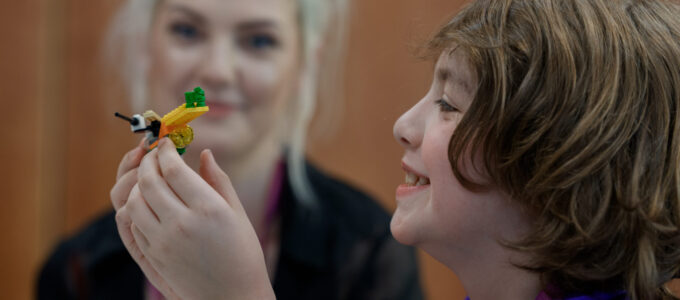
What does healthcare feel like through the eyes of a child? At Children’s Health Scotland, we know that children and young people are experts in their own lives. Yet too often, conversations about healthcare happen around them rather than with them. That’s why we were delighted to bring children, young people, parents, carers and professionals together for a LEGO® Serious Play workshop at our My Health, My Rights Conference, creating a space where experiences could be explored through creativity, storytelling and play.
Facilitated by Tom using the LEGO® Serious Play methodology, the workshop encouraged participants to build models representing their healthcare experiences, the challenges they face, and their hopes for the future. What followed was a powerful conversation about children’s healthcare rights, told through bricks, imagination and lived experience.
Why Play Matters
Play is much more than fun. Play is serious business. For children and young people, play can be a powerful way to communicate thoughts, feelings and experiences that may be difficult to put into words. Through creative activities, children can share their perspectives in ways that feel natural, safe and engaging.
Rhianne Forrest, Officer for Children’s Health Scotland, said:
Children are experts in their own lives. Through play, they showed us what it feels like to be stuck on a waiting list, to feel unheard and to face barriers to accessing support, but they also showed us what good healthcare could look like. They built bridges, connections and solutions. Their models reminded us that children don’t just want services delivered to them; they want to be listened to, involved and respected. That’s exactly what children’s healthcare rights are all about.
Play is one of the most powerful ways children communicate their thoughts, feelings and experiences. Through LEGO® Serious Play, children and young people were able to express experiences that can be difficult to put into words. By creating safe, creative and playful opportunities for participation, we gain genuine insight into children’s lived experiences and can work alongside them to shape meaningful change.
Across the workshop, participants built far more than models. They built stories, experiences and solutions.
Building the Barriers
Many of the first models created represented the obstacles children and families encounter when trying to access healthcare.
- Clocks appeared frequently, symbolising long waits for appointments, support and answers. Walls emerged throughout discussions, representing barriers that can make healthcare feel difficult to navigate.
- Participants spoke about uncertainty, confusion and the feeling of being sent from service to service without knowing where to turn next. Some models contained winding paths and signposts pointing in multiple directions, reflecting journeys that often feel more complicated than they should.
- One particularly striking model showed a child sitting patiently with their hand raised.
- The message behind it was simple but powerful: asking for help and wondering whether anyone is listening.
- Another recurring theme was waiting.
As one participant explained:
The wait might be 8, 12, 24 or 48 hours.
While the numbers may vary, the feeling was one many families recognised. Waiting can mean uncertainty, anxiety and the sense that life is being put on hold.
“Get Down to My Level and Listen”
Throughout the workshop, children and young people repeatedly highlighted the importance of being heard.
One participant described what they wanted from healthcare professionals in just six words:
Get down to my level and listen.
It was a reminder that participation is not simply about asking children for their views. It is about ensuring they feel respected, understood and involved in decisions about their care.
Children spoke about wanting information presented in ways they could understand, opportunities to ask questions and healthcare professionals who take time to listen to what matters to them.
These conversations reflected one of the core messages of the My Health, My Rights Charter: children have the right to be involved in decisions affecting their health and wellbeing.
Creating a More Welcoming Healthcare Experience
The workshop wasn’t only focused on challenges. Participants also spent time imagining what good healthcare could look like.
Some built waiting rooms filled with colour, nature and sensory-friendly spaces. Others created environments that encouraged play, comfort and connection.
One participant summed up their vision of positive healthcare with a simple phrase:
Come in, you’re welcome.
Those four words sparked an important conversation.
For many children and young people, healthcare can be intimidating. A welcoming environment can help reduce anxiety and make children feel more comfortable accessing support.
Participants emphasised that healthcare should feel child-friendly, inclusive and designed with children’s needs in mind.
From Walls to Bridges
As the workshop progressed, something interesting began to happen.
- The walls appearing throughout many of the models started to change.
- Participants added pathways, doors, ladders and bridges.
- The discussion shifted from barriers to solutions.
One participant described their model as:
Bridging the gap.
Whether discussing communication between services, relationships between professionals and families, or transitions between different parts of the healthcare system, participants consistently emphasised the importance of connection.
Children and families should not have to work so hard to make the healthcare system work for them.
Instead, they envisioned healthcare services working together, sharing information and creating seamless support around the child.
The bridge became a powerful symbol of what children wanted healthcare to be: connected, accessible and supportive.
“My Chicken, Much Like Health, Can Be Scary”
Perhaps the most memorable quote of the day came during a discussion about health-related fears.
Pointing to a model they had created, one participant said:
My chicken, much like health, can be scary.
The comment brought smiles around the room, but it also captured an important truth.
Healthcare can feel frightening.
Whether facing tests, procedures, appointments, uncertainty or long-term conditions, many children experience moments of fear and anxiety throughout their healthcare journey.
The beauty of LEGO® Serious Play is that it allows children to communicate these feelings through metaphors and storytelling. A chicken becomes more than a chicken. It becomes a way of expressing worries, concerns and experiences in a way that feels safe and accessible.
When Everything Clicks Together
One participant built a model representing their vision of ideal healthcare.
Several pieces sat close together but were not yet connected.
As they explained their thinking, they pressed the bricks firmly into place until they clicked.
That click represented something important:
- Healthcare working together.
- Professionals communicating.
- Children being listened to.
- Families receiving support without having to fight for it.
- Services joining the dots so children don’t have to.
It was a simple moment, but one that perfectly captured the aspirations shared throughout the workshop.
Thank You
We would like to extend our sincere thanks to Tom for expertly facilitating the LEGO® Serious Play workshop and creating a space where children, young people, families and professionals could share their experiences openly and creatively.
Most importantly, thank you to every child, young person and family member who contributed their ideas, stories and lived experiences.
Through bricks, imagination and play, they helped us better understand the realities of navigating healthcare as a child in Scotland today.
Their message was clear.
- Children want healthcare that listens.
- Healthcare that welcomes.
- Healthcare that works together.
- Healthcare that respects their rights.
By listening to children’s voices and learning from their experiences, we can begin to build the bridges needed to create a healthcare system that truly works for every child.
This workshop was part of our My Health, My Rights Conference which was supported by The National Lottery Community Fund Scotland – Awards For All. We’d like to thank them for giving children the opportunity to explain how healthcare feels in a way that’s right for them. Our Conference was brought together thanks to our Health Rights Defenders.
Want to learn more about them? Check out their webpage by CLICKING HERE.