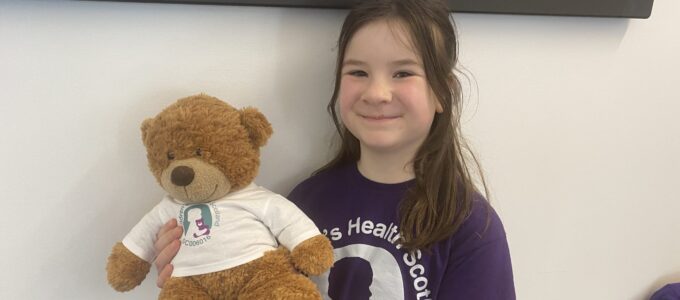
Elodie is ten. She’s thoughtful, creative, and clear about one thing: children deserve to be listened to when it comes to their health. She also knows how often decisions are made around children rather than with them, which is why she’s a Health Rights Defender.
As a Health Rights Defender, Elodie gives her time, ideas and creativity to help adults understand what it’s really like to grow up with a health condition. Not the theory. The reality. What works, what doesn’t, and what needs to change.
For Elodie, this role isn’t about formal meetings or professional language. It’s about finding ways to explain her experiences clearly and creatively and making sure adults genuinely hear them.
“Being a Health Rights Defender is about defending children’s health rights. It’s really fun. We make films sometimes, do stop‑motion animation, and come up with different ways so adults can hear our voices.”
There’s something quietly powerful in that. Children recognising when something isn’t working. Children using creativity as a way to be understood. Children speaking up, not for praise, but because it matters.
When children are listened to properly, they don’t just share opinions. They offer insight. And that’s where real change starts.
As Elodie explains simply:
“We use these ideas to help children’s rights.”
Recently, Elodie and other Health Rights Defenders were given the chance to experience the power of storytelling in a whole new way. Thanks to the generosity of the Royal Shakespeare Company, they attended Matilda the Musical at the Edinburgh Playhouse.
From the moment the lights went down, the theatre became a place where children’s voices led the story. A place where imagination fought back against unfairness. A place where being small didn’t mean being powerless.
Watching Matilda unfold, it was hard not to see the parallels. A young person learning that even when the world feels too loud, there is strength in thinking, creating, and speaking up. That sometimes courage doesn’t roar sometimes it’s quiet, thoughtful, and determined.
For many of our Health Rights Defenders, that feeling is familiar. There are times when health systems are overwhelming. Times when decisions are made about children instead of with them. Times when waiting, worry, and uncertainty fill the space.
And yet — like Matilda — they find ways to respond. Through creativity. Through collaboration. Through volunteering their voices so other children might be heard sooner, clearer, better.
When Elodie reflects on the experience, her joy shines through:
“Matilda was also really fun, it was amazing really cool!”
But it was more than a fun night at the theatre. It was a moment of recognition. A reminder that stories about brave, thoughtful children belong to real children too especially those who are already standing up for fairness in ways adults often underestimate.
Volunteering as a Health Rights Defender is about recognising the insight children already have and choosing to listen to it. Many bring lived experience of health conditions, systems and services. As Health Rights Defenders, they decide what to share and how to share it, using their own ideas, words and creative approaches. What they bring is listened to with care and treated as knowledge that can influence thinking and change.
Just like in Matilda, where children imagine a future that feels safer and kinder, our Health Rights Defenders are doing the same not someday, but now.
We are incredibly grateful to the Royal Shakespeare Company for gifting these tickets and for recognising the importance of children’s voices. Their generosity created excitement, connection and a sense of belonging — and reminded our Health Rights Defenders that their stories deserve a stage.
Because when children are listened to, when grown‑ups really hear them, change becomes possible.
And as Elodie and her fellow Health Rights Defenders show us, sometimes the most powerful thing a child can do…
Which is be themselves.
OUR SMS PROGRAMMES
Our Health Rights Defenders are children and young people aged 9-17 living with a health condition or concern. They’ve taken part in our Self-Management Skills Programmes which are designed to help children feel more confident, build self esteem, cope with stress and know more about their Health Rights. These SMS Programmes are six weeks long and run through the year. They are completely free and don’t require a diagnosis to take part. Professionals can refer or you can self refer by CLICKING HERE.